
Sweepstakes Casino Legal States 2026: Approved US Regions
 Available in US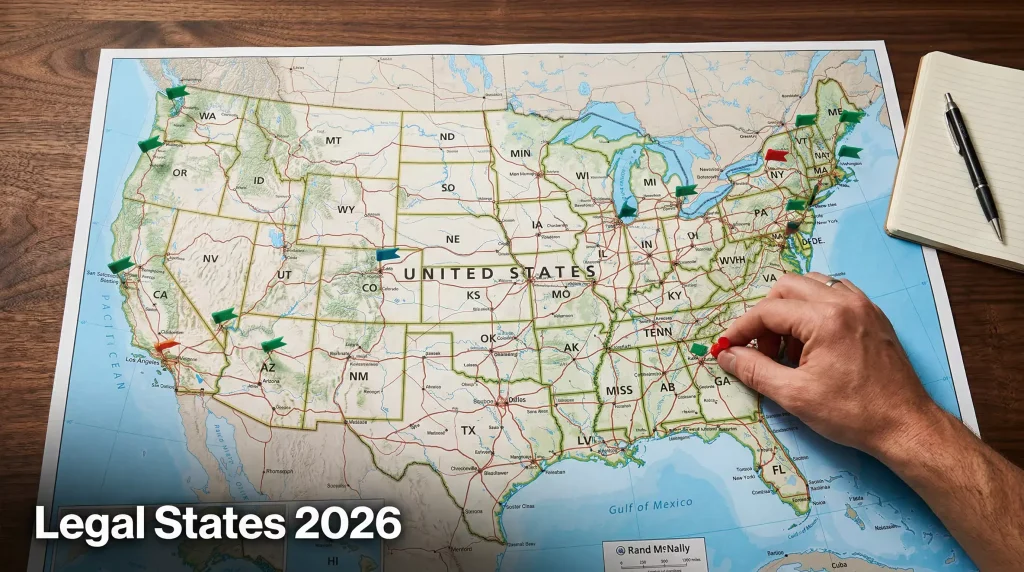
At the start of 2026, sweepstakes casinos operated in most US states with little meaningful opposition. By the beginning of 2026, nine or more states have either banned them outright or created conditions that forced operators to withdraw. Five of those bans were enacted in a single year. The regulatory landscape hasn’t just shifted — it has fractured.
For players, this creates a practical problem that no FAQ page on any sweepstakes casino site addresses honestly: the legality of your participation depends entirely on where you live, and that answer is changing faster than most platforms update their terms of service. A state that was green six months ago may be red today. A state currently listed as accessible may have pending legislation that could flip its status before the next legislative session ends.
This article maps the current state of play across all 50 states as of early 2026. We’ll categorize jurisdictions by status, examine the key states that drove the 2026 crackdown, list the nine states weighing new bans, and explain the legally ambiguous territory between a formal legislative prohibition and an attorney general’s cease-and-desist letter. If you’re wondering whether sweepstakes casinos can legally operate where you are — or for how much longer — the answer starts with geography and ends with legislation that, in many cases, is still being written.
2026 State-by-State Legal Map: Approved and Banned Regions
The US map for sweepstakes casino legality in 2026 falls into three broad categories, though the boundaries between them are less clean than most operator websites suggest.
Green states — where sweepstakes casinos operate openly — still constitute the majority. These are jurisdictions where no specific legislation prohibits the sweepstakes model, no attorney general has issued a formal opinion against it, and operators continue to accept players without restriction. Most of the Midwest, Southeast, and Mountain West falls into this category as of early 2026, though “green” should not be mistaken for “endorsed.” In most of these states, the sweepstakes model simply hasn’t attracted legislative attention yet.
Red states — where sweepstakes casinos are either explicitly banned by statute or functionally blocked — now number nine or more. This group includes Washington, Idaho, and Michigan (which had restrictions predating the 2026 wave) alongside New York, California, Connecticut, Montana, and New Jersey, all of which enacted new prohibitions during the 2026 legislative cycle. Operators have ceased accepting registrations and, in most cases, frozen existing accounts in these jurisdictions.
The financial impact of losing these markets is substantial. California alone accounted for 17.3% of all US sweepstakes casino sales in 2026 — roughly $2.42 billion out of an estimated $14.31 billion in total revenue, according to Eilers & Krejcik Gaming data prepared for the Social Gaming Leadership Alliance. Florida, another state under active legislative pressure, represented 8.5% of operator revenue — over $1 billion in purchases. These are not marginal markets. Losing them reshapes the entire revenue geography of the industry.
Yellow states occupy the ambiguous middle ground. These are jurisdictions where the legal status of sweepstakes casinos is uncertain — either because an attorney general has issued informal guidance against them, because class action lawsuits are challenging the model’s legality, or because proposed legislation is pending but hasn’t been enacted. Players in yellow states can typically still access sweepstakes platforms, but operators may restrict certain features, limit promotional offers, or add additional disclaimers to account for elevated legal risk.
The yellow category is expanding. As more states examine the sweepstakes model through legislative hearings and attorney general investigations, jurisdictions that were solidly green a year ago are drifting toward yellow. The direction of movement is unambiguous: no state has moved from restrictive to permissive in the past two years. The traffic flows one way, and the question for remaining green states is not whether they’ll face scrutiny, but when.
State-by-State Status: Key Jurisdictions Explained
Not every banned state arrived at the same conclusion through the same path. The details matter — both for understanding the legal logic and for predicting which states might follow.
New York moved aggressively in 2026, driven by the office of Attorney General Letitia James. New York’s sweepstakes casino market was substantial — Eilers & Krejcik estimated $762 million in sales in 2026 alone. The state’s position was unequivocal. As the AG’s office argued, according to a WilmerHale legal analysis, “Betting cash-redeemable virtual coins on games of chance constitutes gambling, regardless of how the casino operator characterizes how players can obtain the virtual coins.” That reasoning — cutting through the dual-currency framing to focus on the economic substance of the transaction — has become a template for other states’ enforcement actions. New York’s approach matters beyond its borders because it established that the sweepstakes legal defense could be dismantled by a state attorney general without waiting for new legislation — a precedent that other AGs have since studied closely.
California passed AB 831, signed by Governor Newsom on October 11, 2026, with the ban taking effect January 1, 2026. The bill passed unanimously in both chambers — 36-0 in the Senate and 63-0 in the Assembly. That unanimity is worth noting. In a state where gambling legislation is typically contentious (California has rejected multiple sports betting ballot measures), the sweepstakes ban attracted zero opposition. AB 831 went further than most state bans by extending liability to vendors, payment processors, and technology providers that facilitate sweepstakes casino operations — a provision that could complicate the supply chain for operators nationwide.
Connecticut joined the ban wave in 2026, leveraging its existing regulatory framework for iGaming and sports betting to argue that sweepstakes casinos constitute unlicensed competition. The state’s approach focused on protecting its regulated market — Mohegan Sun and Foxwoods operate the state’s licensed online gambling platforms — rather than on consumer protection arguments alone.
Montana enacted its ban through legislation targeting the sweepstakes model specifically. The state has a history of restrictive gambling laws and a small but politically influential tribal gaming sector that viewed sweepstakes casinos as unregulated competition for player attention and spending.
New Jersey represents the most commercially significant iGaming market in the US, and its decision to ban sweepstakes casinos was widely anticipated. The state’s Division of Gaming Enforcement had been monitoring sweepstakes operators for years, and the formal ban aligned New Jersey’s position with its substantial financial interest in protecting licensed revenue — the state’s iGaming market alone generates hundreds of millions in annual tax receipts.
Washington and Idaho had effectively blocked sweepstakes casinos before the 2026 wave, through a combination of broad gambling statutes and attorney general opinions. Michigan took a more targeted approach, with regulatory actions against specific operators rather than blanket legislative prohibitions, though the practical result — operators ceasing to serve the state — was the same.
The pattern across these jurisdictions reveals a consistent legislative rationale: states with established regulated gambling markets (New Jersey, Connecticut, New York) move faster because sweepstakes casinos threaten existing tax revenue. States with restrictive gambling cultures (Idaho, Montana) move on moral or regulatory grounds. California’s unanimous vote suggests a rare convergence of both motivations — protecting potential future iGaming revenue while responding to constituent complaints about unregulated gambling access.
Five States That Banned Sweepstakes Casinos in 2026
The 2026 legislative cycle was a watershed for sweepstakes casino regulation. Five states — New York, California, Connecticut, Montana, and New Jersey — enacted new bans within a single year, more than doubling the number of jurisdictions with explicit prohibitions. The speed was remarkable. In 2023, no state passed a sweepstakes casino ban. In 2026, the conversation was mostly theoretical — hearing testimony, commissioning studies, circulating draft bills. In 2026, five governors signed legislation into law.
California’s AB 831 set the pace and the tone. Its unanimous passage sent an unmistakable signal to other state legislatures: banning sweepstakes casinos carries no political cost. No lawmaker in either chamber voted against it. No major lobbying campaign materialized in opposition. The sweepstakes industry, despite generating billions in revenue, had not built the kind of political infrastructure — PAC contributions, lobbying relationships, constituency mobilization — that typically insulates an industry from legislative action. By the time operators recognized the threat, the votes were already counted.
New York’s ban followed California’s by weeks, driven less by legislative process than by executive enforcement. The AG’s office moved first, with the legislature codifying the prohibition afterward. This enforcement-first approach is significant because it demonstrates that states don’t necessarily need new legislation to act — existing gambling statutes, combined with a willing attorney general, can achieve the same practical result.
Connecticut and New Jersey both framed their bans explicitly in terms of market protection. Both states operate regulated iGaming markets. Both collect significant tax revenue from licensed operators. And both characterized sweepstakes casinos as unlicensed competitors siphoning player spending without contributing to state coffers. This economic framing — rather than moral or consumer-protection arguments — is likely to be the most potent weapon in future state-level fights, because it aligns the interests of regulators, legislators, and the incumbent gambling industry.
Montana’s ban was quieter but equally definitive, rooted in the state’s traditionally restrictive approach to gambling. The combined effect of all five bans removed an estimated 25–30% of the sweepstakes casino industry’s US addressable market in a single year. For operators, the losses are not hypothetical — they show up directly in revenue reports and user acquisition metrics, particularly the disappearance of California and New York, which together represented nearly a quarter of all industry sales.
The timing of these bans also matters. Most took effect in the second half of 2026 or on January 1, 2026, meaning their full financial impact will not be visible in industry data until mid-2026 reporting cycles. Analysts at Eilers & Krejcik have already adjusted their forecasts downward, projecting a decline in net revenue to $3.6 billion in 2026 — a 10% year-over-year contraction that reflects both the loss of banned-state revenue and the chilling effect on player acquisition in states where legislation is pending.
Nine More States Weighing Bans in 2026
The 2026 bans may have been the opening salvo, not the final word. According to reporting from Sweepsy.com, nine additional states are actively considering or expected to consider sweepstakes casino prohibitions during the 2026–2026 legislative session: Indiana, Maine, Arkansas, Maryland, Mississippi, Florida, Illinois, Ohio, and Massachusetts.
Indiana Gaming Commission Chairman Nate Friend has been among the most vocal state regulators on the issue. As Friend stated, Indiana is one of nine states tackling the sweepstakes casino question during the current legislative cycle — a figure that reflects coordinated information-sharing among state gaming commissions rather than independent, unrelated legislative efforts.
The nine states considering action represent a diverse cross-section of the US gambling landscape. Florida and Illinois are major population centers with established gambling industries — Florida through its tribal compacts and pari-mutuel operations, Illinois through its extensive casino and video gaming terminal network. Both have strong financial incentives to curb unregulated competition. Maryland and Massachusetts operate regulated casino markets and have shown increasing willingness to scrutinize adjacent gambling products. Ohio, which legalized sports betting in 2023, is examining whether sweepstakes casinos undermine its carefully constructed regulatory framework.
Mississippi and Arkansas represent a different dynamic. Both are Southern states with significant brick-and-mortar casino industries — Mississippi’s Gulf Coast casinos are a major economic driver — where sweepstakes platforms are seen as digital competitors that bypass the local regulatory and tax infrastructure entirely. Maine, with a smaller gambling market, has nonetheless introduced legislation targeting the sweepstakes model in response to constituent complaints.
Not all nine states will necessarily pass bans. Legislative timelines, lobbying efforts, and political dynamics will determine which proposals advance and which stall. Indiana’s bill appears furthest along, with bipartisan committee support and the backing of the state’s gaming commission. Florida’s situation is complicated by its existing Seminole gaming compact and ongoing legal disputes over online gambling jurisdiction. Illinois, with its massive video gaming terminal network, has strong incumbent interests pushing for sweepstakes restrictions but also a complex legislative calendar crowded with competing priorities.
The industry’s response to pending legislation has been inconsistent. Some operators are lobbying for regulatory frameworks that would allow them to continue operating under state oversight — essentially seeking to be regulated rather than banned. Others are taking a wait-and-see approach, continuing to serve players in pending states while building war chests for potential legal challenges. A few have begun voluntarily withdrawing from states where legislative momentum appears irreversible, preferring to exit on their own terms rather than face a statutory deadline.
For players in these nine states, the practical implication is uncertainty with an expiration date. The current legislative sessions will resolve the question for most of these jurisdictions within the next 12 to 18 months. The direction is clear. The states considering action share a common calculation: the sweepstakes casino industry generates revenue from their residents without contributing tax revenue, operating under regulatory oversight, or adhering to responsible gambling standards. That asymmetry — between what regulated operators are required to do and what sweepstakes operators choose to do — is the argument that has proven most potent at getting platforms legislated off the map.
Gray Zones: Cease-and-Desist vs Legislative Ban
The distinction between a legislative ban and a cease-and-desist order matters more than most players realize. A legislative ban is a statute — codified law that explicitly prohibits sweepstakes casino operations within a jurisdiction. Violating it carries defined legal penalties. A cease-and-desist, by contrast, is an administrative action — typically issued by an attorney general or a state gaming commission — that demands an operator stop certain activities but doesn’t necessarily carry the same statutory weight.
In practice, both produce the same immediate result: operators leave the market. No major sweepstakes casino has publicly defied a state attorney general’s cease-and-desist order, because doing so would invite enforcement action, potential injunctions, and the kind of public legal battle that no operator — particularly those in a legally ambiguous industry — wants to fight. But the legal distinction creates ongoing uncertainty. A cease-and-desist can be challenged in court. A statutory ban cannot be easily reversed without new legislation.
The litigation landscape compounds this ambiguity. In 2026, over 100 class action lawsuits were filed against sweepstakes casinos across the country. VGW, the operator behind Chumba Casino — the largest platform in the market — alone faced more than 20 individual lawsuits. These suits generally allege that sweepstakes casinos operate illegal gambling enterprises, that the dual-currency model is a sham designed to circumvent gambling laws, and that players were harmed by participating in what they believed was legal entertainment.
The outcomes of these lawsuits vary. Some have been dismissed — courts in certain jurisdictions have accepted the sweepstakes defense and ruled that the no-purchase-necessary pathway breaks the legal chain of consideration. Others have resulted in settlements, including a notable $11.75 million settlement by VGW. Still others are ongoing, creating a patchwork of conflicting judicial interpretations that offers neither operators nor players clear guidance.
This patchwork is the defining feature of the gray-zone landscape. In one state, a court may rule that the sweepstakes model is a legitimate promotional game. In the neighboring state, a different court may rule that the identical model constitutes illegal gambling. Federal courts have offered no unifying precedent, and the issue has not reached the Supreme Court. Until it does — or until Congress acts, which appears unlikely in the near term — the legality of sweepstakes casinos will continue to be determined state by state, court by court, and sometimes attorney general by attorney general.
For players in gray-zone states, the practical advice is simple but uncomfortable: the fact that you can access a sweepstakes casino from your state does not necessarily mean the activity is legal there. Operators use geolocation technology to block access from banned states, but they generally do not restrict access from states where the legal question is merely unresolved. The absence of a block is not an endorsement of legality. It simply means the operator has not yet been forced to withdraw.
How to Verify if a Casino Operates in Your State
Verifying whether a sweepstakes casino operates in your state requires more than checking the platform’s marketing materials. Operators have a financial incentive to accept players from as many states as possible, and their public communications don’t always reflect the most current legal landscape.
Start with the operator’s terms and conditions — specifically the section on eligibility or restricted jurisdictions. This is the legally binding document, not the homepage banner. Look for a list of states where the platform does not operate. If your state appears, the answer is definitive. If your state doesn’t appear on the restricted list, it means the operator is currently accepting players from your jurisdiction, but it does not mean the activity is explicitly legal under your state’s laws.
Next, check your state attorney general’s website for any public opinions, advisory letters, or enforcement actions related to sweepstakes casinos. Several AGs have issued guidance without pursuing formal legislative bans, and these opinions — while not carrying the force of statute — indicate the direction of regulatory sentiment. A state AG who has publicly questioned the legality of sweepstakes casinos is a state where the legal ground may shift quickly.
Your state’s gaming commission or gambling control board is another resource. States with regulated gambling industries maintain public databases of licensed operators and, increasingly, lists of entities that have been warned or ordered to cease operations. If a sweepstakes casino appears on a state regulator’s watch list, that’s a strong signal of elevated legal risk.
Finally, track legislative activity. State legislature websites publish bill texts, committee hearing schedules, and voting records. If your state has an active sweepstakes-related bill in committee, the legal status could change within months. Waiting until a ban is signed into law to take action — withdrawing funds, completing redemptions, exporting transaction records — means operating on a timeline set by legislators rather than by your own risk tolerance.