
Sweepstakes Slots Games: US Casino Reviews and Data Analysis
 Available in US
No hype. No affiliate bias. Just data.

US Sweepstakes Slots Games: Independent Data, Real Analysis, No Affiliate Bias
The US sweepstakes casino industry crossed .6 billion in gross revenue in 2024, according to data compiled by KPMG from Eilers & Krejcik Gaming research. That is not a typo. A sector built on the legal premise that it is not gambling now generates more revenue than the entire global social casino market. And yet, if you search for information about sweepstakes slots games, you will mostly find affiliate listicles ranking casinos by commission rate rather than player value.
This guide exists because the gap between the industry's size and the quality of independent coverage is embarrassing. We do not accept affiliate payments. We do not rank platforms by who pays us the most. What we do is pull data from regulatory filings, analyst reports, and court documents, then present it with data-backed clarity so you can make decisions rooted in evidence rather than marketing copy.
What follows is a comprehensive analysis of the sweepstakes slots landscape in the United States as it stands in 2026 — market economics, the dual-currency model, legal status across all fifty states, RTP transparency, bonus mechanics, and the responsible gaming data that most publications conveniently skip. If a number appears in this guide, it has a source. If a claim lacks one, we say so.
US Sweepstakes Slots Market Data: Player Statistics and Revenue
- The sweepstakes casino industry hit .6 billion in gross revenue in 2024, but revised 2026 forecasts project the first-ever decline to .6 billion net — driven by bans in nine states including California and New York.
- Players redeemed over billion in real cash prizes in 2024, with operator payout rates of 65-70%. Only 12% of users ever make a purchase.
- Sweepstakes slots often use identical game builds and RTP configurations as regulated iGaming platforms, but lack mandatory audit requirements — fairness is possible, verification is not guaranteed.
- Nine additional states are considering bans in 2026, and over 100 class action lawsuits were filed against operators in 2025 alone.
- Twenty million American adults reported problematic gambling behaviors in the most recent NCPG survey, with men aged 18-34 at highest risk — the same demographic sweepstakes casinos are growing fastest among.
A Billion Industry Nobody Regulates
Sweepstakes casinos were a niche curiosity five years ago. By 2024, the sector had surpassed .6 billion in gross revenue (sales) and .4 billion in net revenue, per KPMG's June 2025 industry primer citing Eilers & Krejcik Gaming's Social Sweepstakes Gaming Monitor. The compound annual growth rate from 2020 to 2024 hovered between 60% and 70% — a pace that makes fintech unicorns look pedestrian.
For context, the entire global social casino market — the segment sweepstakes casinos technically belong to — generated approximately .1 billion in gross revenue in 2024. That means the sweepstakes subcategory alone already dwarfs its parent category by a factor of nearly 1.5x. The student has overtaken the teacher, and neither regulators nor the public fully appreciate the scale of what is happening.
Projections for 2025 originally pointed toward .3 billion in gross revenue and .6 billion net. But the regulatory crackdowns we cover later in this guide prompted Eilers & Krejcik to revise their net revenue forecast downward — from .7 billion to billion, a 17.5% haircut. The adjusted figure still represents 16% year-over-year growth. Their 2026 outlook is more sobering: .6 billion in net revenue, a projected 10% decline. Growth is not dead, but it is entering a new phase defined by contraction in banned states and consolidation among survivors.
The demographic profile tells its own story. Roughly 58% of sweepstakes casino users fall between 25 and 44 years old, and more than 40 new operators launched between 2024 and 2025, per Racine County Eye reporting on Action Network data. The pace of new entrants is remarkable — sweepstakes casinos were acquiring new players at three times the rate of licensed online casinos in the second half of 2024, according to an Optimove study cited by Snell & Wilmer. That velocity brought revenue, but it also brought attention from attorneys general, state legislators, and the American Gaming Association — all of whom now want the party to end, or at least to charge an entry fee.
Macquarie analyst Aaron Lee noted that the sector achieved roughly 75% CAGR from 2019 to 2023, but cautioned that this growth could ultimately catalyze iGaming legalization rather than cannibalize it — with social casinos, not regulated operators, being the more likely casualty if market overlap intensifies, as reported by Casino.org.

The sweepstakes casino market grew from a rounding error to a .6 billion industry in under five years, but revised forecasts and regulatory pressure suggest 2026 will be the first year of meaningful contraction.
The Dual-Currency Engine Behind Sweepstakes Slots
The legal architecture of sweepstakes casinos rests on one structural trick: separating what you pay from what you win. Players purchase Gold Coins — a virtual currency with no cash value — and receive Sweeps Coins as a free bonus. The Gold Coins let you play for entertainment. The Sweeps Coins are the ones that can be redeemed for real cash prizes. Because the prize-eligible currency is technically free, operators argue the model does not constitute gambling under most state laws. Traditional gambling requires three elements: consideration (payment), chance, and prize. Remove the payment from the prize pathway, and you remove the legal definition of gambling — or so the theory goes.
The theory works, until it does not. But the mechanics are worth understanding on their own terms before we get to the legal challenges.
When you buy a Gold Coin package — say, 10,000 Gold Coins for .99 — the platform attaches a bonus of Sweeps Coins to the purchase. The ratio varies by operator and promotional period, but typical packages include anywhere from 1 to 30 Sweeps Coins per purchase. You play slots, table games, or other titles using whichever currency you choose. Gold Coin play is purely recreational. Sweeps Coin play accumulates a balance that, once you clear minimum thresholds and identity verification, converts to real dollars.
The conversion economics are revealing. Only about 12% of sweepstakes casino users ever make a first purchase, compared to over 50% on licensed gambling apps, according to RG.org's analysis of free-to-play monetization. That 12% figure hides a steep power curve: average revenue per user across the entire base runs between and per month, per Gaming Innovation Group's investor presentation data. But ARPPU — average revenue per paying user — is disproportionately high because a small segment of heavy spenders, sometimes called whales, accounts for a large share of total revenue. Customer acquisition costs range from to 0 per player, which means operators need each paying user to stick around for months before they turn a profit.
This is not a charity model. It is a freemium funnel with a gambling-shaped product at the center, engineered to convert a small percentage of users into recurring buyers while keeping the rest engaged with free play. The dual-currency mechanic is both the legal shield and the monetization engine, and understanding it is the prerequisite for evaluating anything else about this industry.
Sweepstakes casinos monetize through a freemium model with a 12% purchase conversion rate. The dual-currency structure — Gold Coins for fun, Sweeps Coins for prizes — is the legal and financial backbone of the entire sector.
Gold Coins Buy Fun — Sweeps Coins Buy Payouts
Gold Coins and Sweeps Coins look similar on screen. They spin the same reels, trigger the same bonus rounds, and land on the same paylines. The difference is entirely in what happens when you finish playing.
Gold Coins are the entertainment currency. You receive them through purchases, daily login bonuses, social media promotions, and free-to-play events. They cannot be redeemed for cash under any circumstances. Think of them as arcade tokens — useful inside the building, worthless outside. Most platforms are generous with Gold Coins precisely because they cost the operator almost nothing to distribute and serve the purpose of keeping players active and familiar with the game library.
Sweeps Coins are the prize currency. You earn them as bonuses attached to Gold Coin purchases, through mail-in requests (the Alternative Method of Entry, or AMOE), promotional giveaways, and sometimes daily login rewards. When you play with Sweeps Coins and accumulate a balance above the minimum redemption threshold — typically 50 to 100 SC — you can convert them to real dollars through a verified payout process. The operator payout rate sits at approximately 65% to 70% of total Gold Coin purchases, meaning players collectively redeemed more than billion in cash prizes during 2024, according to RG.org market analysis.

That billion figure is not a misprint. It is the volume of real money flowing back to players from a system that insists it is not gambling. Whether you view this as a generous prize model or an elaborate legal workaround depends on your perspective, but the cash is real, the tax obligations are real, and the distinction between Gold Coins and Sweeps Coins is the single most important concept for anyone entering this space.
Sweepstakes Slots vs Licensed iGaming: What the Numbers Say
The comparison between sweepstakes casinos and licensed real-money online casinos is not just academic — it is the fault line along which the entire regulatory battle is being fought. On paper, the two look similar: both offer slots, table games, and real monetary outcomes. In practice, they operate under fundamentally different legal, financial, and regulatory frameworks.
The regulated US commercial gaming industry set a record in 2025 with .72 billion in gross gaming revenue, a 9.2% year-over-year increase, according to the AGA Commercial Gaming Revenue Tracker. That figure includes land-based, sports betting, and iGaming revenue. The iGaming segment alone crossed billion in monthly revenue for the first time in December 2025, hitting .03 billion — a 22.4% increase. These operators pay state gaming taxes. They submit to regulatory audits. They comply with responsible gaming mandates.
Sweepstakes casinos, by contrast, pay no state gaming taxes. Their .6 billion in gross revenue generates zero direct tax revenue for state coffers. This is the central grievance of the regulated industry, and it is not a trivial one — the AGA estimates that unregulated platforms including sweepstakes casinos, skill machines, and prediction markets have cost states in the hundreds of millions in lost tax revenue.
Player perception adds another layer. A 2025 AGA survey of 2,250 respondents found that 90% of sweepstakes casino users believe they are gambling, regardless of the legal framework the operator uses to classify the activity, as reported by PlayUSA. Tres York, VP of Government Relations at the AGA, summarized the regulated industry's position bluntly: consumers recognize sweepstakes casinos for what they are, and the promotional framing does not change the underlying reality of the experience.
The game libraries overlap significantly. Many sweepstakes casinos license the same titles from the same providers — Pragmatic Play, BGaming, Hacksaw Gaming — that supply regulated iGaming platforms. The RTP configurations can be identical. The visual experience is indistinguishable. What differs is the regulatory wrapper: one side has licenses, audits, and tax obligations; the other has terms of service and a dual-currency disclaimer.
For players, the practical differences come down to availability, verification requirements, and payout mechanics. Sweepstakes casinos are accessible in far more states than licensed iGaming (which operates in fewer than ten states as of 2026). They typically have lower identity verification barriers at signup, though KYC becomes mandatory at the redemption stage. Payouts can be slower and less predictable than at regulated platforms. Whether the trade-off is worthwhile depends on where you live and how much regulatory oversight matters to you.
Legal State Map 2026: Where You Can and Cannot Play
The legal landscape for sweepstakes casinos in the United States is shifting faster than most operators can adapt. As of early 2026, at least nine states have enacted outright bans or effectively shut down sweepstakes casino operations through legislative action and regulatory enforcement, according to Gambling Insider's January 2026 market analysis. The list of states with active prohibitions includes Washington, Idaho, New York, California, Connecticut, Montana, New Jersey, and Michigan, with several others using attorney general enforcement actions rather than formal legislation.
Five of those bans were enacted in a single year — 2025. New York, California, Connecticut, Montana, and New Jersey all passed legislation explicitly targeting sweepstakes casinos during their 2025 sessions. The speed was remarkable. California's AB 831, which Governor Newsom signed on October 11, 2025, passed both chambers unanimously: 36-0 in the Senate and 63-0 in the Assembly, as documented by ZwillGen's legal analysis. That kind of bipartisan unanimity is rare on any issue; it signals the depth of opposition the industry faces in states with established gaming interests.
The financial implications of these bans are staggering. California accounted for an estimated 17.3% of all sweepstakes casino sales in the US — roughly .42 billion of the projected .31 billion gross revenue in 2025, per Eilers & Krejcik data reported by Sweepsy. New York represented approximately 2 million in sweepstakes purchases in 2024, according to EKG data compiled for the Social Gaming Leadership Alliance. Losing these two states alone strips a quarter of the industry's addressable market.
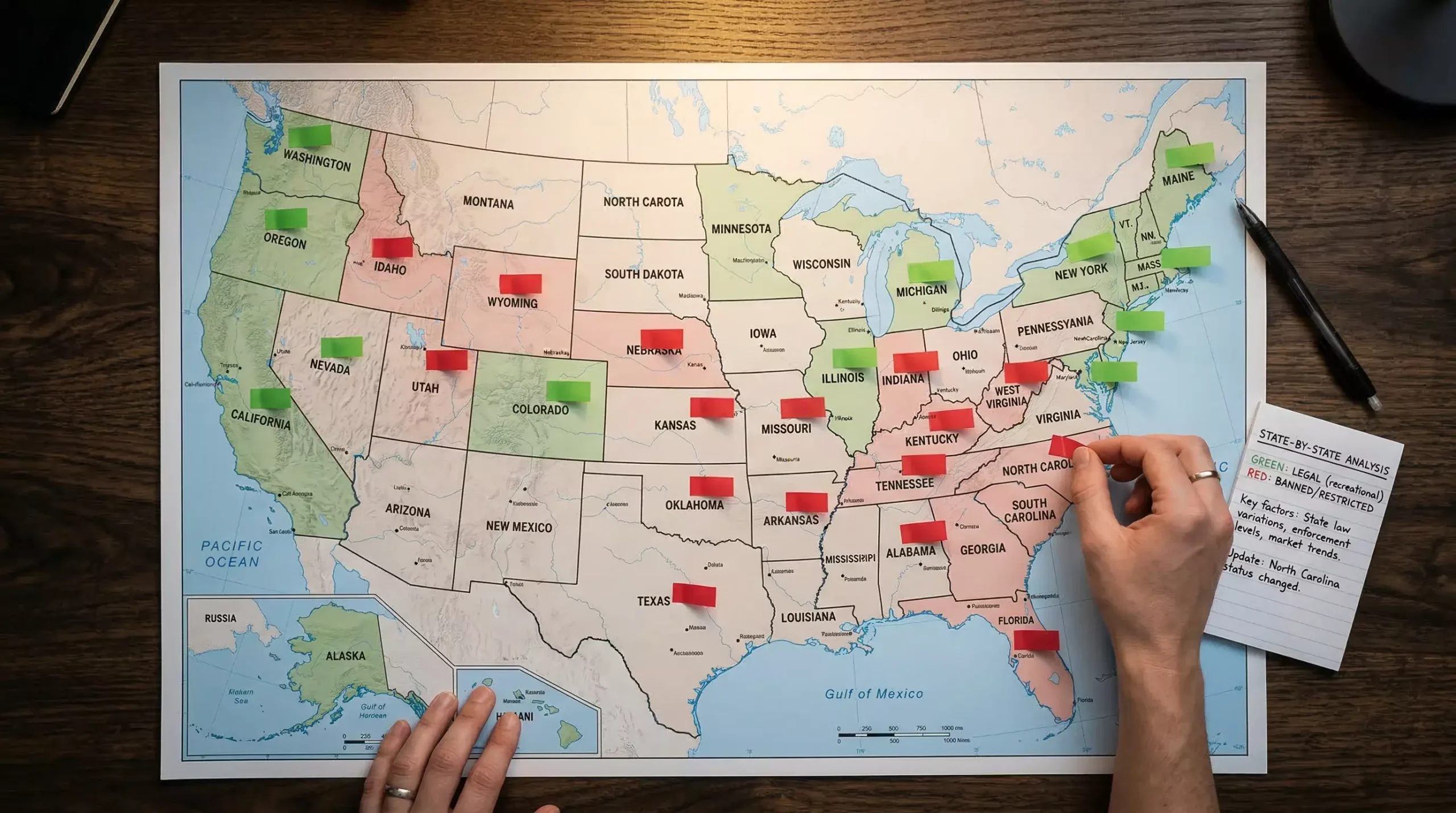
The picture is not uniformly restrictive. The majority of US states still permit sweepstakes casinos to operate, either because they have no specific legislation addressing the model or because their existing sweepstakes laws accommodate the dual-currency framework. States like Pennsylvania, Texas, Ohio, and Georgia remain active markets, though several of those are now among the nine jurisdictions considering new restrictions.
Nate Friend, Chairman of the Indiana Gaming Commission, confirmed in early 2026 that nine states are actively considering or will consider sweepstakes casino bans during the 2025-2026 legislative session: Indiana, Maine, Arkansas, Maryland, Mississippi, Florida, Illinois, Ohio, and Massachusetts, as reported by Sweepsy. Florida alone accounted for 8.5% of operator revenue in 2025 — more than billion in purchases. If even half of these states pass bans, the market contraction would be severe.
At least nine states have already banned sweepstakes casinos, and nine more are considering legislation in 2026. California and New York — together representing roughly a quarter of industry revenue — enacted bans in 2025.
Where sweepstakes casinos remain operational, the product itself has evolved far beyond basic slot machines.
Slot Categories: Megaways, Hold & Win, Jackpots, and Niche Formats
Sweepstakes casinos have moved well past the days of basic three-reel fruit machines. The current game libraries at major platforms draw from the same providers — Pragmatic Play, BGaming, Hacksaw Gaming, Betsoft, and others — that supply licensed iGaming operators. That means players get access to the same mechanics, themes, and bonus structures found at regulated online casinos, delivered through the dual-currency framework.
Megaways slots remain one of the most popular formats. The mechanic, originally developed by Big Time Gaming, uses a variable reel system where each spin generates a random number of symbols per reel — anywhere from two to seven — creating up to 117,649 ways to win on a single spin. Cascading wins compound the excitement: winning symbols disappear, new ones drop in, and the process repeats until no new wins form. Titles like Gates of Olympus and Sugar Rush are staples across most sweepstakes platforms.
Hold & Win slots occupy a different niche. The core mechanic triggers a respin round when a set number of special symbols — usually coins or orbs — land on the same spin. During the feature, only the triggered symbols stay locked in place while the remaining positions respin a fixed number of times, typically three. New special symbols that land during respins reset the counter. The feature ends when no new symbols appear or when the entire grid fills, triggering a grand jackpot. These games appeal to players who prefer the anticipation of a prolonged bonus round over the rapid-fire cascading of Megaways.
Progressive jackpot slots pool a fraction of every wager into a growing prize pool that pays out when specific conditions are met — usually a random trigger or a maximum-tier feature completion. Some sweepstakes platforms offer standalone progressives, while others run network progressives that link multiple titles together. Jackpot values in the sweepstakes space tend to be smaller than their real-money counterparts, because the prize pool accumulates in Sweeps Coins rather than direct wagers, but significant payouts have been documented at several platforms.
Beyond the major categories, sweepstakes casinos also host crash games (instant-win formats where a multiplier rises until it crashes, and players must cash out before it does), fish games (arcade-style shooters with skill elements and multiplier-based payouts), scratch cards (digital instant-win tickets with predetermined prize structures), and bingo variants. The diversity of formats means sweepstakes casinos are no longer just slot platforms — they are full-spectrum gaming destinations operating under a single regulatory gray area.
RTP and House Edge: Do Sweepstakes Slots Play Fair?
Return to Player is the metric that separates informed players from hopeful ones. RTP represents the theoretical percentage of total wagers that a game returns to players over an extended period — typically millions of simulated spins. A slot with a 96% RTP retains 4% as the house edge. That 4% is the operator's margin, and it is built into the math model of every game before you ever press spin.
The relevant finding for sweepstakes players is that many platforms use the same certified game builds as licensed real-money operators. According to Lines.com's analysis of sweepstakes slot RTP data, titles like Blood Suckers carry the same 98% RTP configuration whether they appear on a regulated iGaming site or a sweepstakes platform, provided the operator has selected the same configuration from the provider. This is not guaranteed — providers often offer multiple RTP tiers, and operators choose based on their margin targets — but it does mean that sweepstakes slots are not inherently rigged compared to their regulated counterparts.
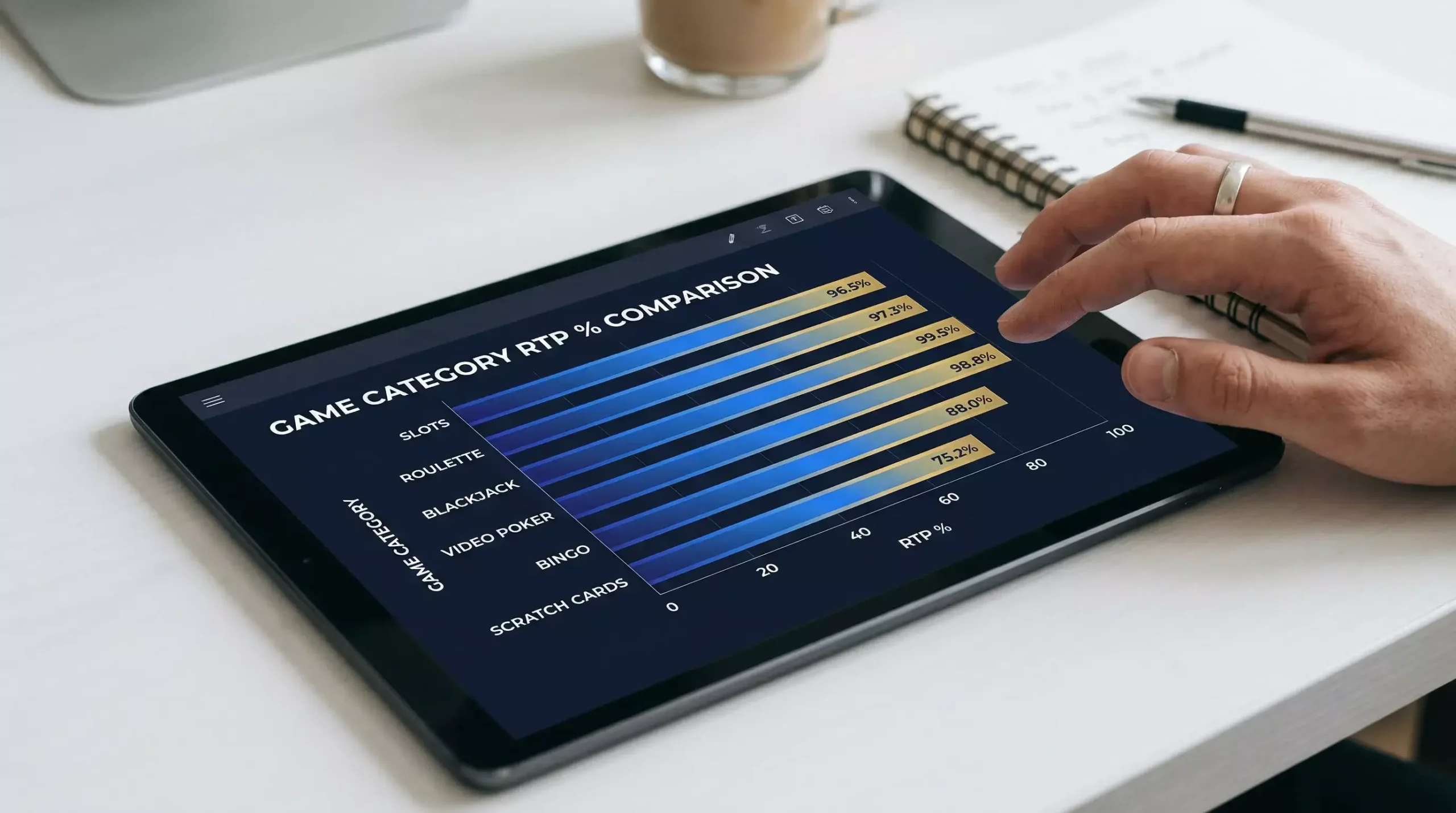
The house edge across sweepstakes slot games generally ranges from 1% to 7%, depending on the title and the RTP configuration the operator has selected. For comparison, blackjack offers a house edge as low as 0.5% with optimal strategy, and European roulette sits at 2.7%. Sweepstakes slots fall on the higher end of that spectrum for most games, but high-RTP titles can bring the edge below 3%. The variance matters too: a high-volatility slot with a 96% RTP will produce long dry stretches punctuated by larger wins, while a low-volatility game with the same RTP delivers more frequent but smaller payouts.
One critical caveat: unlike regulated iGaming operators in states like New Jersey or Michigan, sweepstakes casinos are generally not required to publish RTP data or submit to third-party audits. Some do so voluntarily — particularly those using certified provider builds — but there is no regulatory mandate ensuring transparency. This is the gap that matters most for players. A 96% RTP means nothing if you cannot verify it, and most sweepstakes operators leave that verification entirely up to the game provider, with no independent regulator checking the math.
Sweepstakes slots can carry the same RTP as regulated casino games, but the absence of mandatory audit requirements means players must rely on provider certifications rather than regulatory oversight to verify fairness.
Bonus Structures: What's Real, What's Marketing
Every sweepstakes casino leads with its welcome offer. The language is calibrated to sound generous: "Get 250,000 Gold Coins + 25 Free Sweeps Coins on Signup!" Strip away the presentation and what remains is a fairly standard freemium onboarding flow designed to get you playing and, ideally, purchasing.
Welcome bonuses typically combine a block of Gold Coins (no cash value) with a smaller allocation of Sweeps Coins (redeemable). The Gold Coins keep you occupied while the Sweeps Coins give you a taste of playing for real stakes. Some platforms offer no-deposit bonuses — meaning you receive Sweeps Coins simply for registering and verifying your account, without buying anything. These tend to range from 1 to 10 SC and come with playthrough requirements before redemption is possible.
Playthrough requirements are the fine print that separates a genuine bonus from a marketing ploy. A 1x playthrough means you need to wager the Sweeps Coins once before redemption — relatively player-friendly and the standard at most established platforms. A 3x playthrough means you must wager three times the bonus amount, extending the time and volatility before you can cash out. The difference between 1x and 3x on a 25 SC bonus might seem trivial, but over thousands of spins at varying house edges, it meaningfully reduces the expected value of the bonus.
Beyond welcome offers, most platforms run daily login bonuses (small Gold Coin and occasional SC allocations), purchase bonuses (extra SC when buying Gold Coin packages, sometimes doubled during promotional windows), referral bonuses (rewards for inviting friends who sign up and play), and social media giveaways. The AMOE path — Alternative Method of Entry via postal mail — also yields free Sweeps Coins, though the process involves mailing a handwritten request to the operator and waiting several weeks for the credit to appear.
The honest assessment: bonuses at sweepstakes casinos are structurally similar to those in the broader freemium gaming industry. They are designed to reduce the friction of first engagement and create a sense of value. Some offer genuine opportunities to play with redeemable currency at minimal or no cost. Others are dressed-up retention mechanics that look better on a landing page than in your account balance. Reading the terms before playing is not paranoia — it is basic due diligence.
From Sweeps Coins to Cash: The Redemption Pipeline
Accumulating Sweeps Coins is the easy part. Turning them into dollars in your bank account involves a process that most platforms explain poorly and execute inconsistently.
The redemption flow generally follows a predictable sequence. First, you must meet the platform's minimum balance threshold — usually between 50 and 100 SC. Second, you complete identity verification (KYC), which requires a government-issued ID, proof of address, and sometimes a selfie or utility bill. Third, you select a redemption method: bank transfer, PayPal, Skrill, or in some cases a prepaid card. Fourth, you wait. Processing times range from 24 hours at the fastest platforms to 7-10 business days at the slower ones, and first-time redemptions almost always take longer due to the verification step.
The aggregate numbers confirm that the redemption pipeline works at scale. Operator payout rates run at roughly 65% to 70% of total Gold Coin purchases, per RG.org's market data. That rate is lower than what you would see at a regulated online casino, where rates typically exceed 90%, but it reflects the dual-currency structure: a significant portion of play happens with Gold Coins, which generate no payout obligations at all.
Common friction points include delayed KYC approvals (some platforms take days to verify documents), redemption limits (many cap weekly or monthly cashouts at ,000 or ,000), and occasional account reviews that freeze balances during investigation. None of these are unique to sweepstakes casinos — regulated platforms have similar processes — but the lack of a regulatory body to appeal to if something goes wrong makes the stakes higher for players who encounter issues.
Responsible Gaming: The Data the Industry Ignores
This is the section most sweepstakes casino guides either skip or reduce to a tokenistic "play responsibly" disclaimer. We are going to do something different and look at the actual data, because the numbers tell a story that the industry would prefer you not read.
The National Council on Problem Gambling's NGAGE 3.0 survey, published in 2025 with data from 2024, found that approximately 20 million American adults experienced at least one problematic gambling behavior "many times" in the previous year. That figure is actually a decline from 27.5 million in the 2021 survey — representing a drop from 11% to 8% of the adult population. The improvement is real, but 20 million people is still a staggering number.
The demographic distribution is uneven and concerning. Men aged 18 to 34 reported the highest rates of problematic behavior at 15%, compared to just 2% among adults over 55, according to NCPG data reported by Covers.com. That 18-34 male demographic is also the primary growth audience for sweepstakes casinos. Frequency matters too: 35% of people who gambled three or more times per week reached the threshold for "at-risk" behavior, per the NCPG findings. The correlation between access, frequency, and harm is well-established in gambling research, and sweepstakes casinos — available 24/7 on mobile devices with minimal barriers to entry — are optimized for exactly the kind of frequent engagement that elevates risk.
Public perception lags behind the data. Only 39% of Americans consider gambling addiction a "very serious" problem, compared to 62% for drug addiction and 55% for alcoholism. That perception gap translates directly into funding gaps. The median per-capita spending on problem gambling programs across US states is just
.35 per person — not per gambler, per person in the entire state population. Some states spend literally nothing.
Derek Longmeier, President of the NCPG Board of Directors, acknowledged the progress while emphasizing the gap: national efforts in responsible gambling and public awareness are producing measurable improvements, but the work remains incomplete, as stated in the NCPG's press release accompanying the NGAGE 3.0 findings. He was more direct on the funding question, arguing that everyone who profits from gambling — including government — bears an ethical responsibility to direct some of that revenue toward mitigating harm, as quoted by Covers.com.
The regulated gaming industry has invested in responsible gambling infrastructure. The AGA reported 0 million in cumulative RG investment, with programs generating 3 million for state-level intervention and treatment, per the AGA's 2025 industry results webinar. Sweepstakes casinos, operating outside the regulated framework, have no equivalent mandate. Some platforms offer self-exclusion tools, deposit limits, and session timers voluntarily. Others offer nothing beyond a link to a helpline in their terms of service. The inconsistency is the problem.

If you play sweepstakes slots — or any form of gambling — and find that your sessions are getting longer, your purchases are increasing, or your mood is affected by outcomes, those are signals worth paying attention to. The 1-800-GAMBLER helpline operates 24/7. The NCPG website offers a confidential self-assessment and state-by-state treatment referrals. Using these resources is not a sign of weakness; it is the only rational response to a product category designed to maximize engagement.
Regulatory Reckoning: 2026 and the Road Ahead
The sweepstakes casino industry entered 2026 facing a regulatory environment that has shifted from benign neglect to active hostility in under eighteen months. The convergence of legislative bans, class action lawsuits, and a vocal regulated gaming lobby has created a pressure cooker with no obvious relief valve.
The litigation numbers alone tell a story. More than 100 class action lawsuits were filed against sweepstakes casino operators across the United States in 2025, with VGW — the parent company of Chumba Casino — facing over 20 lawsuits individually, per Gambling Insider's market contraction report. The legal theory in most of these cases is straightforward: plaintiffs argue that sweepstakes casinos are de facto gambling operations that evade state gambling laws through a dual-currency fiction. Courts have not reached a consistent conclusion, but the volume of litigation is imposing operational costs and reputational damage regardless of outcomes.
The industry's most powerful critic, the American Gaming Association, has framed the issue in existential terms. AGA President and CEO Bill Miller has characterized sweepstakes casinos as operations that exploit consumer confusion and threaten the public trust built over years of regulatory compliance, as reported by Yogonet. The AGA's position is not neutral advocacy — its members are the regulated operators who lose market share to unregulated competitors — but the argument about tax fairness carries weight with legislators. Sweepstakes casinos, skill machines, and prediction markets do not pay state gaming taxes. The AGA has estimated that unregulated gaming platforms cost states over 0 million in lost tax revenue since early 2025, according to the AGA Commercial Gaming Revenue Tracker.
The financial picture reinforces the legal one. As we detailed in the market overview, Eilers & Krejcik has already revised their 2026 net revenue forecast down to .6 billion — the first projected decline in the sector's history. The legislative calendar makes further downward revisions plausible.
With nine additional states actively weighing bans, the operator response has been mixed. The Social and Promotional Gaming Association (SPGA) has positioned its members as operating within established legal frameworks with consumer protections and responsible gaming practices in place. Some operators have proactively exited states before bans take effect. Others are investing in legal challenges to new legislation. A few are exploring paths to obtaining state gaming licenses — effectively conceding that the sweepstakes model may have a limited shelf life and pivoting toward the regulated framework they spent years avoiding.
The most likely outcome is a fractured landscape: some states will ban, some will regulate, and others will continue ignoring the issue until the volume of player activity forces their hand. For players, the practical advice is simple — verify your state's current status before playing, assume that the legal environment may change during your time on a platform, and keep records of purchases and redemptions in case regulatory shifts affect your account.
Over 100 class action lawsuits, nine pending state bans, and the first-ever projected revenue decline signal that 2026 is the year sweepstakes casinos face their regulatory reckoning.
Frequently Asked Questions
Are sweepstakes casinos legal in the United States?
Sweepstakes casinos operate legally in the majority of US states by using a dual-currency model that separates the purchase transaction from the prize-eligible currency. However, at least nine states have enacted bans or effectively prohibited their operation as of early 2026, including New York, California, Washington, Idaho, Connecticut, Montana, New Jersey, and Michigan. Nine additional states are considering restrictions during the current legislative session. Legality depends on your specific state, and the landscape is changing rapidly — always verify your state's current status before signing up or making purchases.
Can you actually win real money at sweepstakes casinos?
Yes. Sweeps Coins accumulated through gameplay can be redeemed for real cash prizes once you meet the platform's minimum threshold (typically 50-100 SC) and complete identity verification. Players collectively redeemed over billion in cash prizes from sweepstakes casinos in 2024. The process involves KYC verification and processing times that range from 24 hours to 10 business days depending on the platform. Redemption is only available through Sweeps Coins — Gold Coins have no cash value under any circumstances.
How do sweepstakes slot RTPs compare to regular online casino slots?
Many sweepstakes casinos license the same game builds from the same providers (Pragmatic Play, BGaming, Hacksaw Gaming) used by regulated iGaming operators, which means the RTP configurations can be identical. Sweepstakes slot house edges generally range from 1% to 7%. However, unlike regulated online casinos in states like New Jersey or Michigan, sweepstakes platforms are not required to publish RTP data or undergo mandatory third-party audits. The games themselves can be fair, but the lack of regulatory verification is the key difference.
How We Research and Score
Every claim in this guide is sourced from public documents, regulatory filings, analyst reports, or direct industry data. Our primary sources include KPMG industry primers, Eilers & Krejcik Gaming market monitors, the American Gaming Association's revenue tracker and survey data, National Council on Problem Gambling research, state legislative records, and court filings. We do not rely on operator-provided marketing materials or unverified player anecdotes.
When we reference statistics, we cite the original source and provide direct links where available — including PDF documents from KPMG and NCPG, rather than secondary summaries. We note the publication year of every data point so you can assess its recency. Where analyst forecasts have been revised, we include both the original and updated figures for transparency.
We do not accept affiliate commissions, sponsored placements, or advertising revenue from any sweepstakes casino operator. Our assessments are based on publicly verifiable data: game library breadth, RTP transparency, KYC processing times, redemption limits, responsible gaming tools, and legal compliance. If an operator changes its practices, we update accordingly. If we cannot verify a claim, we say so rather than present it as fact.
This methodology is not perfect — no independent publication has access to operators' internal data — but it is a deliberate departure from the affiliate-driven model that dominates sweepstakes casino coverage. Data-backed clarity is not a tagline for us. It is the editorial standard that determines what gets published and what gets cut.