
Sweepstakes Casino vs Social Casino: Real Prize Differences
 Available in US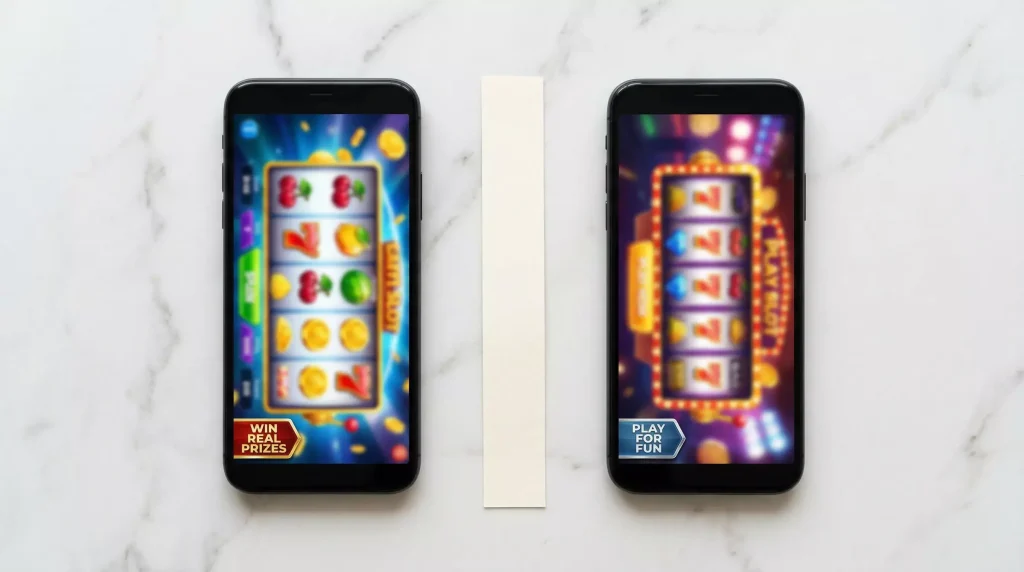
The line between a sweepstakes casino and a social casino is clear on paper: one lets you win real money, the other doesn’t. In practice, the two categories blur constantly — similar game libraries, similar-looking interfaces, similar marketing language. Players who’ve used social casino apps like Slotomania or House of Fun will recognize the gameplay when they open a sweepstakes platform. The difference only becomes apparent when they check the cashier.
That difference is consequential. The global social casino market generated roughly $7.1 billion in gross revenue in 2026, operating entirely on virtual currency with no real-world redemption. Sweepstakes casinos, meanwhile, have grown into a separate and larger market altogether. One pays out, one doesn’t — and the gap between the two models is widening in every metric that matters.
Prize Redemption Value: Entertainment vs Cash Payouts
A social casino is a gaming platform where all currency is virtual, all winnings are virtual, and there is no mechanism to convert anything into real money. You buy coins, you play slots or table games, you win or lose those coins, and that’s it. The appeal is entertainment — the same dopamine loop as traditional gambling, without the financial consequences. Social casinos are legal everywhere because they don’t meet the legal definition of gambling: there’s no prize, so the question of whether “consideration” exists doesn’t matter.
Big social casino brands include Slotomania, House of Fun, DoubleDown Casino, and Zynga Poker. These apps are available through the Apple App Store and Google Play without restriction, generating revenue through in-app purchases of virtual coin packages. The model has been stable for over a decade, and social casino companies are publicly traded entities with straightforward business models: sell virtual entertainment, keep all of it.
A sweepstakes casino uses a fundamentally different structure. The dual-currency model — Gold Coins for entertainment, Sweeps Coins for real prizes — creates a hybrid that looks like a social casino on the surface but functions like a real-money gambling platform underneath. The addition of Sweeps Coins and the AMOE (Alternative Method of Entry) path is what moves these platforms from the social casino category into the sweepstakes category, with all the legal complexity that entails.
The revenue numbers reflect the structural difference. US sweepstakes casinos generated over $10.6 billion in gross revenue in 2026, compared to $7.1 billion globally for social casinos. Sweepstakes revenue has grown faster, attracted more players, and generated more regulatory scrutiny — all because of the redemption mechanism that separates the two models. The games are nearly identical. The business models are not.
From a legal classification standpoint, social casinos sit firmly in the entertainment category. No state has moved to ban social casino apps because there’s no prize at stake. Sweepstakes casinos, by contrast, occupy a contested legal space that an increasing number of states are resolving by treating them as de facto gambling operations. The redemption feature that makes sweepstakes casinos appealing to players is the same feature that makes them a target for regulators.
Market Size: $10.6B Sweepstakes vs $7.1B Social
The market data tells a story of a new category overtaking an established one. Social casinos dominated the free-to-play gaming space for years, but sweepstakes casinos have surged past them in revenue. The sweepstakes sector grew at a compound annual growth rate of 60–70% between 2020 and 2026 — a pace that makes most tech growth metrics look modest. Social casinos, by comparison, have grown in the low single digits annually over the same period.
The growth disparity has prompted analysis about whether sweepstakes casinos are cannibalizing social casino revenue. Macquarie analyst Aaron Lee has offered a nuanced view, suggesting that sweepstakes growth may actually catalyze iGaming legalization rather than permanently divert players from regulated markets. If cannibalization does occur, Lee argues, social casinos are the more likely victim — not licensed iGaming operators, who offer a fundamentally different product with full regulatory backing.
The player overlap between social and sweepstakes casinos is significant but not complete. Social casinos appeal to a broad demographic that includes casual gamers with no interest in real-money gambling. Sweepstakes casinos attract a subset of that audience — players who enjoy the social casino gameplay but want the possibility of real payouts. The Sweeps Coin redemption feature is the conversion trigger: it transforms a casual entertainment activity into something that feels, and in many respects functions, like gambling.
Revenue per user also differs meaningfully. Social casino ARPU is driven entirely by virtual coin purchases with no expectation of return. Sweepstakes ARPU includes both Gold Coin purchases and the anticipation-driven spending that the Sweeps Coin mechanism generates. Players who believe they can win real money tend to spend more — and more frequently — than players who know everything they buy is purely virtual. The redemption possibility isn’t just a feature; it’s the engine that drives sweepstakes revenue past social casino benchmarks.
What the Distinction Means for Players
For players deciding between the two models, the choice comes down to what you want from the experience.
If you want pure entertainment with zero financial risk beyond your coin purchases, social casinos deliver exactly that. You’ll never lose real money (beyond what you spend on coins), you’ll never need to provide KYC documentation, and you’ll never worry about state-level bans affecting your access. The games are solid — many social casinos carry titles from the same providers that supply sweepstakes platforms — and the progression systems, loyalty rewards, and social features are often more developed than what sweepstakes casinos offer.
If the possibility of winning real money is important to you, sweepstakes casinos are the only free-to-play option that provides a path from gameplay to cash. The Sweeps Coin mechanism creates genuine financial stakes, even if you never purchase a Gold Coin package (free SC through AMOE means you can play for prizes without spending). That added dimension changes the psychology of play — wins feel more significant, losses sting more, and the overall engagement tends to be more intense.
The trade-offs are real on both sides. Social casinos have no payout infrastructure to fail, no KYC to delay your experience, and no regulatory risk to shut down your state’s access. Sweepstakes casinos offer real-world returns but come with verification requirements, state restrictions, playthrough terms on bonuses, and the possibility that legislative action could end your access. The apps look similar. The implications of choosing one over the other are not.
There’s also a responsibility dimension worth considering. The psychological research on gambling harm applies to sweepstakes casinos in ways it doesn’t to social casinos. When real money is achievable — even through free entry methods — the behavioral patterns associated with problem gambling can emerge. Social casinos carry their own engagement risks (some studies link heavy social casino use to later real-money gambling), but the immediate financial exposure is fundamentally lower.
One final practical note: you can use both. Many players maintain accounts on both social and sweepstakes platforms, using social casinos for low-stakes entertainment and sweepstakes platforms when they’re interested in prize-eligible play. The game overlap between the two categories is significant enough that switching back and forth doesn’t require learning new mechanics — just different expectations about what happens with your winnings. Choose the model that matches your goals on any given day, and keep your relationship with risk honest.