
Sweepstakes Casino KYC Verification: Document Requirements
 Available in US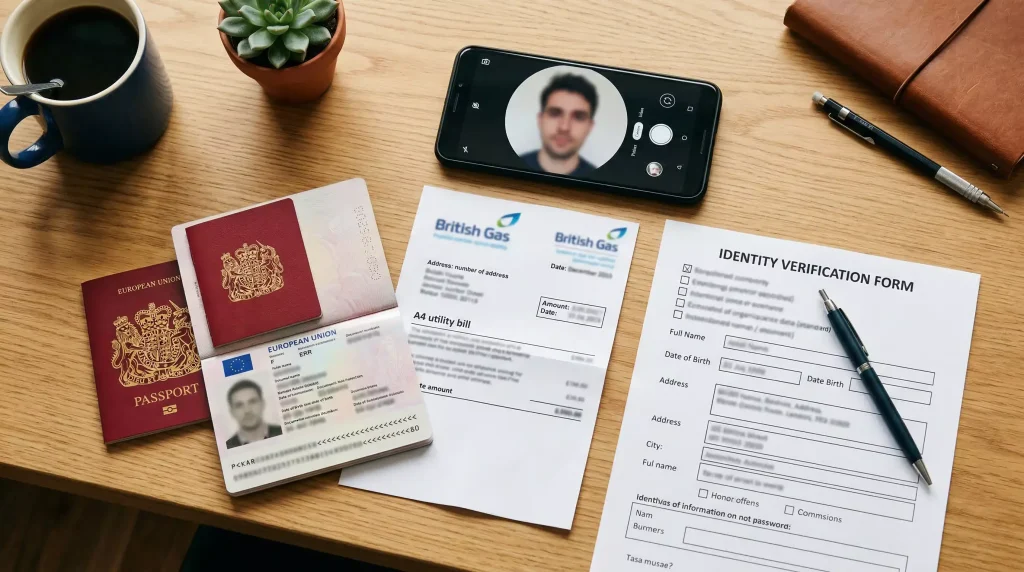
You can sign up at a sweepstakes casino in under two minutes. Name, email, date of birth, state — done. But the moment you try to turn Sweeps Coins into real money, the platform asks for something more: a photo of your driver’s license, proof of your address, and sometimes a selfie with your ID held next to your face. This is KYC — Know Your Customer — and it’s the checkpoint between playing and actually getting paid.
KYC exists at sweepstakes casinos for the same reason it exists at banks and brokerage accounts: to verify that you are who you claim to be, that you’re old enough to participate, and that you reside in an eligible jurisdiction. The difference is that sweepstakes platforms trigger the process later than most financial services — not at account opening, but at first redemption. Verified before you cash out, not before you play. That sequencing shapes the entire experience.
Mandatory KYC Documents: ID Verification and Address Proof
The standard KYC package at a sweepstakes casino includes three document categories. The specific requirements vary by platform, but the core set is consistent across the industry.
Government-issued photo ID. A driver’s license, state ID card, or passport. The document must be current (not expired), display your full legal name, date of birth, and photo. Most platforms accept scans or high-resolution photos taken with a smartphone camera. The name on the ID must match the name on your casino account exactly — nicknames, middle name discrepancies, or mismatched spellings will trigger a rejection.
Proof of address. A utility bill, bank statement, or official government letter dated within the last 90 days. The document must show your full name and residential address. PO boxes are generally not accepted. Some platforms also accept a lease agreement or mortgage statement. The address must match the jurisdiction you registered from — if you signed up claiming residency in Texas but submit an address proof from New York, the verification will fail.
Selfie verification. An increasing number of platforms require a live selfie or a photo of you holding your ID next to your face. This step confirms that the person submitting the documents is the person pictured on the ID. Some platforms use automated facial recognition matching; others rely on manual comparison by a compliance team member.
The reason these checks exist is straightforward: over $7 billion in Sweeps Coins were redeemed for cash in 2026. That volume of real-money payouts requires identity verification to prevent fraud, money laundering, and underage access. KYC is the mechanism that transforms an anonymous online account into a verified identity attached to a real payment method.
A few platforms require additional documentation in specific circumstances. High-value redemptions (typically above $2,000–$5,000 in a single request) may trigger enhanced due diligence, which can include source-of-funds documentation or additional identity checks. Players who have changed their name since their ID was issued may need supplementary legal documents (marriage certificate, court order). Accounts flagged for suspicious activity may face expanded requirements at the operator’s discretion.
Processing Times, Rejections, and Resubmission
Processing times are the most common source of player frustration with KYC. The advertised timelines and the actual timelines don’t always align, and understanding why helps manage expectations.
First-time verification typically takes 24–72 hours on well-staffed platforms. Smaller operators or those experiencing high demand may take 5–7 business days. The bottleneck is manual review — most sweepstakes casinos don’t have fully automated verification systems. A human reviews your documents, compares them against your account data, and either approves or rejects. During peak periods (after major promotions, during holiday weekends), the queue lengthens.
Common rejection reasons include blurry or partially obscured photos where critical information isn’t legible, expired documents, name mismatches between your account and your ID, address documents older than 90 days, and selfies that don’t clearly match the ID photo (poor lighting, low resolution, or obstructed features). Each rejection resets the processing clock — you’ll need to resubmit corrected documents and wait through the queue again.
Resubmission tips. Photograph documents on a flat, well-lit surface. Ensure all four corners are visible. Avoid flash glare on laminated IDs — angle the camera slightly off-center. For selfies, use natural light and hold the ID at chin level. Submit all required documents in a single batch rather than one at a time, since partial submissions can trigger additional back-and-forth with the compliance team.
The KYC situation at sweepstakes casinos highlights a broader structural issue. Surveys show 90% of sweepstakes casino users consider these platforms to be gambling — yet the verification and consumer protection standards applied to them remain substantially below those required of licensed gambling operators. Licensed iGaming platforms must verify identity before gameplay begins, face regulatory deadlines for processing withdrawals, and submit to external audits of their compliance procedures. Sweepstakes casinos set their own timelines, staffing levels, and acceptance criteria, with no external regulatory body enforcing standards.
Repeat verifications. Once your KYC is approved, subsequent redemptions typically process without re-verification — unless the platform’s systems flag your account for periodic review (common at 6–12 month intervals) or you attempt to change your registered payment method. Keeping your account information consistent avoids triggering unnecessary re-checks.
Data Handling: How Operators Protect Your Identity
Handing over your driver’s license and proof of address to an online casino raises legitimate privacy concerns. Here’s what to know about how sweepstakes platforms handle your data — and where the protections fall short.
Data storage and encryption. Reputable sweepstakes casinos encrypt KYC documents both in transit (using TLS/SSL) and at rest (using AES-256 or equivalent encryption). Documents are stored on secure servers with access restricted to authorized compliance personnel. The industry standard is to retain KYC records for a period specified in the platform’s privacy policy — typically 5–7 years after account closure, driven by anti-money-laundering best practices even where they’re not legally mandated.
Third-party verification services. Some platforms outsource document verification to specialized KYC providers (companies like Jumio, Onfido, or Shufti Pro). These services handle the document analysis and identity matching, returning a verification result to the casino without the casino needing to store full document images. This approach can improve both speed and security, since the third-party provider is purpose-built for identity verification and often holds certifications (SOC 2, ISO 27001) that the casino itself may not.
Where protections are weaker. Sweepstakes casinos aren’t subject to the same data protection regulations as licensed gaming operators in states like New Jersey, which mandate specific security standards, breach notification requirements, and regular audits. A sweepstakes platform’s privacy practices are governed by their own privacy policy and applicable general privacy laws (like state consumer protection statutes), but there’s no gaming-specific regulatory body checking compliance.
Practical steps. Before submitting KYC documents, read the platform’s privacy policy — specifically the sections on data retention, third-party sharing, and breach notification. If the privacy policy is vague, missing, or doesn’t address how identity documents are handled, that’s a red flag. You can also redact sensitive information that isn’t needed for verification (for example, blacking out your Social Security number on a document that happens to display it, if the platform didn’t ask for it). Submit only what’s explicitly requested — no more.