
Sweepstakes Casino Fish Games: Skill-Based Arcade Betting
 Available in US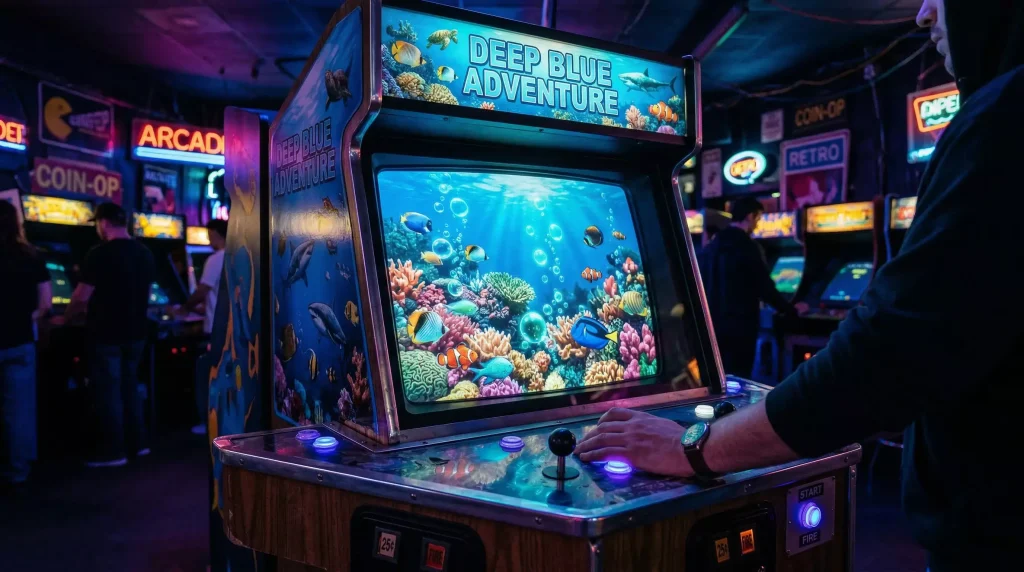
Most sweepstakes casino lobbies look roughly the same — rows of slot thumbnails, a few table games, maybe a crash game section. Then there’s the fish games tab, and suddenly you’re looking at an underwater battlefield where you aim a cannon at animated sea creatures and pull the trigger for multiplied payouts. It’s a different animal entirely.
Fish games are one of the odder corners of the sweepstakes ecosystem. They trace back to arcade cabinets in Asian gaming parlors, migrated to physical sweepstakes terminals in US gas stations and strip malls, and eventually found their way onto online sweepstakes platforms. The genre occupies a unique position: part skill, part chance, fully integrated into the same dual-currency model that powers every other game on the platform. Arcade roots, casino stakes — here’s what that actually means in practice.
Fish Table Mechanics: Skill-Based Multipliers and Payouts
Fish games — also called fish hunter games or fish table games — are arcade-style casino games where players use a virtual cannon to shoot at fish and other sea creatures swimming across the screen. Each target carries a multiplier value. Hit the target, and you receive a payout based on the multiplier and the size of your bet. Miss, and your ammunition (which costs coins per shot) is gone. The core loop is deceptively simple: aim, shoot, collect. But the dynamics underneath that loop are where things get interesting.
Unlike traditional slots, where outcomes are determined entirely by a random number generator the moment you press “Spin,” fish games introduce a layer of player agency. You choose which targets to aim at, when to fire, and how much ammunition to spend on each shot. Higher-value targets — boss fish, golden creatures, special event spawns — are harder to hit and sometimes require sustained fire. Lower-value targets are easier but pay less. The skill element isn’t about overcoming the house edge (the math still favors the operator over time), but about shot selection and ammo management within a session.
The legal framework that allows these games to exist on sweepstakes platforms is the same one governing slots and table games. As Magnus Boberg, founder of JustGamblers, has explained: traditional gambling requires three elements — consideration (payment), chance, and prize. Sweepstakes platforms bypass the consideration element by offering free entry through AMOE, making the entire game library — fish games included — legally distinct from traditional gambling in most states. Fish games don’t get special treatment; they’re wrapped in the same dual-currency structure as everything else on the platform.
What makes fish games appealing to sweepstakes operators is diversification. With over 40 new operators launching in 2026–2026, standing out in a sea of identical slot lobbies requires something different. Fish games attract a player demographic that doesn’t necessarily identify as “slot players” — people drawn to the arcade aesthetic, the active gameplay, and the visual spectacle of underwater battles. They also tend to produce longer session times compared to standard slots, since each round involves continuous interaction rather than a single spin-and-wait cycle.
The games use the same certified provider versions that run on both sweepstakes and licensed real-money platforms. The RTP configurations, random elements, and payout structures are determined by the game provider and remain consistent regardless of whether you’re playing on a sweepstakes site or a regulated iGaming platform. The only variable is whether your winnings are denominated in Gold Coins, Sweeps Coins, or real money — and that depends entirely on which mode and platform you’re using.
Gameplay Mechanics: Shooting, Multipliers, and Skill Elements
A fish game session begins with a shared screen — typically showing an ocean environment with various sea creatures moving in patterns. Multiple players can be in the same room simultaneously, each controlling their own cannon positioned at the edge of the screen. This multiplayer element is another departure from standard slots, where each player operates in isolation.
Your cannon fires projectiles that cost a set number of coins per shot. Most games let you adjust the bet size per shot, usually across a range from minimum (1 coin) to maximum (which varies by game but can reach 100 coins or more per projectile). Higher bet sizes don’t increase your accuracy, but they do increase the payout multiplier when you successfully eliminate a target. A fish worth 5x at a 1-coin bet pays 5 coins; the same fish at a 10-coin bet pays 50.
Target hierarchy and multipliers. Standard fish — small, fast, plentiful — carry multipliers in the 2x–10x range. Medium targets like turtles, sharks, or jellyfish offer 20x–50x. Boss creatures (typically appearing on a timer or as special events) can reach 100x–500x, but they absorb far more ammunition before going down, and there’s no guarantee a boss will be eliminated before it swims off screen. This risk-reward tension is where most of the “skill” perception lives: experienced players learn to calculate whether the expected return on sustained boss fire justifies the ammo expenditure.
Special weapons and power-ups. Many fish games include secondary weapons — bombs that hit all targets on screen, lightning chains that arc between fish, or freeze effects that stop movement temporarily. These consume extra coins but can dramatically increase efficiency during high-density spawns. Some games gate power-ups behind achievement systems or cumulative spending, adding a progression layer that further extends session time.
The RNG underneath. Despite the skill perception, fish games are still governed by random number generation. Whether a shot “kills” a target isn’t determined by aim alone — each shot has a programmed probability of success that the player can’t see. Aiming at a fish and hitting it visually doesn’t guarantee elimination; the server-side RNG decides independently. This means the skill element is real but bounded: you can optimize your target selection and bet sizing, but you can’t overcome the built-in house edge through reflexes alone. Over thousands of shots, the math converges to the game’s preset RTP, just like slots.
Where to Find Fish Games: Platform Availability
Fish games aren’t available at every sweepstakes casino. The genre requires specialized software, and not all game providers offer fish-style titles. Your best bet for finding them is to check the game lobby directly — platforms that carry fish games typically feature them in a dedicated category labeled “Fish Games,” “Arcade,” or “Specialty.”
Several established sweepstakes platforms include fish games in their libraries alongside standard slots and table games. The specific titles vary by platform and by provider agreements, but common fish game brands include Fish Catch, Ocean King, Golden Dragon, and various titles from providers specializing in the arcade-casino crossover space. Newer platforms entering the market in 2026 are more likely to include fish games at launch, recognizing the genre’s ability to attract players who might otherwise skip a slots-only lobby.
Availability also depends on your state. Fish games fall under the same legal framework as all other sweepstakes casino games, meaning they’re accessible wherever the platform operates and restricted wherever sweepstakes casinos are banned. There’s no separate regulatory treatment for the fish genre specifically — a platform that’s geoblocked in your state won’t let you access any games, fish or otherwise.
One thing to check before committing significant time or coins: whether fish games contribute to Sweeps Coin playthrough requirements on the same terms as slots. Some platforms weight game contributions differently, and arcade-style games occasionally have reduced or zero contribution toward bonus wagering. If you’re playing with promotional SC and need to clear a playthrough requirement, confirm that fish games count before sinking your ammo budget into the ocean.
Fish games won’t replace slots as the core of the sweepstakes casino experience. They’re a niche within a niche. But for players who want active gameplay instead of passive spinning — and who don’t mind the arcade aesthetic — they offer something genuinely different from everything else in the lobby. The skill element is real, even if it’s not unlimited. And for a genre that started in physical arcade cabinets, the translation to online sweepstakes platforms has been surprisingly faithful.