
Sweepstakes Casino Table Games: Roulette, Blackjack, and Poker
 Available in US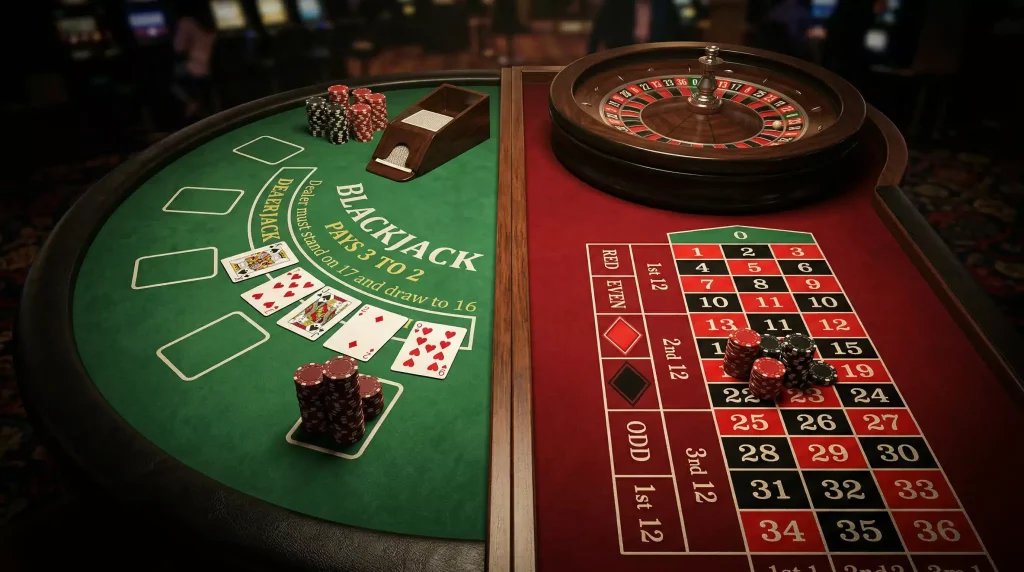
Slots dominate every sweepstakes casino lobby — hundreds of titles, front and center, filling the screen the moment you log in. Somewhere below the fold, usually in a separate tab or filter category, sit the table games. Blackjack, roulette, poker variants, baccarat. They’re quieter, less flashy, and attract a fraction of the traffic. They also offer significantly better odds for the player.
Table games at sweepstakes casinos are RNG-driven digital versions of the classics. No live dealer, no physical cards — just software simulations running the same math as their real-money counterparts. Classic tables in a sweepstakes wrapper. The rules are familiar, the house edge is lower than slots, and the question of whether strategy matters in a dual-currency environment has a clearer answer than most players expect.
Available Table Game Variations: Blackjack and Roulette Rules
The table game selection at sweepstakes casinos is narrower than what you’d find at a full-service iGaming platform, but the core games are well represented across most established operators.
Blackjack. The most widely available table game on sweepstakes platforms. Standard versions follow classic rules: six or eight decks, dealer stands on soft 17, 3:2 payout on natural blackjack. Some platforms offer variants — European blackjack (no hole card), multihand blackjack (play multiple hands simultaneously), or Perfect Pairs (side bet on the first two cards). The interface is straightforward: click to hit, stand, double down, or split, and the RNG resolves each hand instantly.
Roulette. Both European (single zero) and American (double zero) versions appear on most sweepstakes platforms. European roulette is the better option mathematically, though some platforms default to the American version, which has a nearly doubled house edge. A few casinos carry French roulette with La Partage or En Prison rules, which further reduce the edge on even-money bets. Bet placement is drag-and-drop or click-to-place, with results resolved in seconds rather than the 30–60 seconds a physical or live wheel takes.
Video poker. Jacks or Better, Deuces Wild, and Joker Poker are the most common variants. Video poker sits at the intersection of slots and table games — it uses a slot-like interface but involves decision-making (which cards to hold) that directly affects the theoretical return. A Jacks or Better game played with optimal strategy can return over 99.5%, making it one of the highest-RTP options in any sweepstakes casino.
Baccarat. Punto banco baccarat is available on a growing number of platforms. The rules are simple (bet on Player, Banker, or Tie), the game requires no strategy decisions, and the house edge on Banker bets is among the lowest in the casino. Baccarat tends to attract players who prefer low-decision, fast-resolution gameplay.
Poker variants. Casino Hold’em, Three Card Poker, and Caribbean Stud appear on some platforms. These are player-versus-house games (not player-versus-player), with fixed strategy charts that determine optimal play. Availability is less consistent than blackjack or roulette — smaller platforms may not carry poker variants at all.
Other games. Craps, Sic Bo, and Red Dog show up occasionally, though their presence is inconsistent and typically limited to larger platforms with extensive game libraries. If a specific table game is important to you, check the lobby before committing to a platform.
House Edge Comparison: Slots vs Blackjack vs Roulette in SC Mode
The house edge difference between table games and slots is the single most practical piece of information for players who care about maximizing their SC balance. Sweepstakes slots carry a house edge ranging from 1% to 7%, with most titles clustering in the 3–5% range. Table games, by contrast, offer substantially lower edges — provided you play correctly.
Blackjack: approximately 0.5% house edge with basic strategy. This means the casino retains about 50 cents per $100 wagered — a fraction of what slots cost the player over the same volume of bets. Basic strategy charts are freely available online and eliminate guesswork from every decision. Without strategy (hitting and standing on instinct), the edge rises to 2–3%, still better than most slots but significantly worse than optimal play.
European roulette: 2.7% house edge on all bets. American roulette: 5.26% on all bets except the five-number bet (which is 7.89%). The difference comes entirely from the extra zero pocket on the American wheel. If both versions are available on your platform, European roulette is always the better choice.
Baccarat (Banker bet): approximately 1.06% house edge. The Player bet runs slightly higher at 1.24%. The Tie bet carries an edge of 14.36% and should be avoided entirely from a mathematical standpoint.
Video poker (Jacks or Better, optimal strategy): approximately 0.46% house edge. This makes it the lowest-edge game available at most sweepstakes casinos — lower than blackjack, lower than baccarat, and dramatically lower than any slot. The catch is that the edge only holds at optimal play; deviating from the strategy chart increases it significantly.
The practical impact is straightforward. If you’re clearing a playthrough requirement or simply want your SC to last as long as possible, table games with lower house edges cost you less per dollar wagered. The trade-off: many platforms weight table games at 10–20% for playthrough purposes, meaning you need to wager 5–10x more to clear the same requirement as with slots. Check the terms before choosing your clearing strategy.
Do Strategies Apply When Playing with Sweeps Coins?
Yes. Unequivocally. The math doesn’t change because your chips are denominated in Sweeps Coins instead of dollars.
Sweepstakes casinos run the same certified game versions as licensed real-money platforms. The RNG, the rules, and the payout tables are identical. A blackjack hand dealt on a sweepstakes site follows the same probability distribution as one dealt on a licensed iGaming platform or at a physical casino table. Basic strategy works because it’s derived from the mathematical properties of the game, not from the currency being used.
For blackjack, use a basic strategy chart. These charts tell you the optimal action (hit, stand, double, split, surrender) for every possible combination of your hand and the dealer’s upcard. Following the chart reduces the house edge to its theoretical minimum. Deviating from the chart — hitting on 16 against a dealer’s 6 because it “feels right” — increases the edge and costs you money over time.
For video poker, strategy cards serve the same function. They rank every possible hold combination for each hand you’re dealt, ensuring you make the mathematically optimal choice every time. The strategy differs slightly between variants (Jacks or Better vs Deuces Wild), so use the correct card for the game you’re playing.
For roulette and baccarat, no strategy can reduce the house edge — these are pure-chance games where the odds are fixed by the rules. The only “strategy” is game selection: European roulette over American, Banker bet over Tie. Beyond that, the outcomes are random and independent.
One common misconception worth addressing: some players believe that SC mode games are programmed differently from GC mode games — that the RNG behaves differently when real-money-equivalent currency is at stake. There’s no evidence for this, and the major providers deliver a single game build that operates identically in both modes. The provider’s reputation and certification depend on game integrity; configuring different behavior based on currency mode would be a certifiable fraud that would end their business relationships industry-wide.