Sweepstakes Casinos Banned States 2026: Regional Restrictions
 Available in US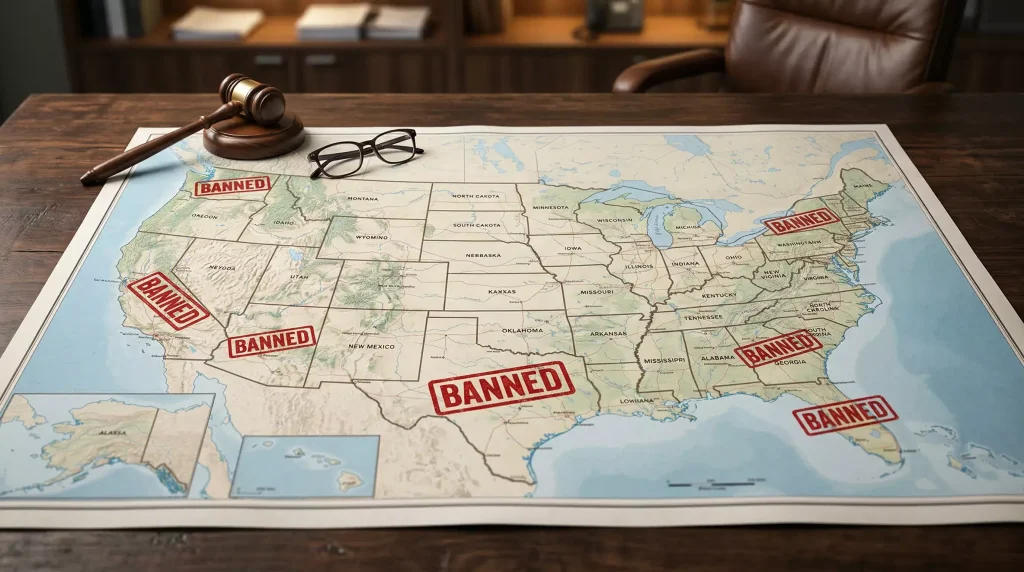
Sweepstakes casinos spent years expanding into virtually every US state with minimal resistance. That era ended in 2026. Five states passed explicit bans last year, bringing the total number of states with outright prohibitions or effective shutdowns to nine or more — a number that’s expected to grow further as at least nine additional states consider similar legislation in their 2026 sessions.
The bans didn’t happen in a vacuum. They followed years of complaints from regulated gaming operators, attorney general investigations, and a growing body of class-action litigation. What changed in 2026 was the speed: states that had been studying the issue for years suddenly moved to legislation, some with bipartisan unanimity that’s rare in any policy area. Banned by statute, not suggestion — here’s the current map and the legislative context behind each restriction.
Complete 2026 Banned Jurisdictions: Blocked US States List
The following states have either passed legislation explicitly banning sweepstakes casinos or taken enforcement actions that have effectively shut down operations as of early 2026. The list is organized by the timing and nature of the restriction.
States with legislative bans passed in 2026:
New York. The state moved against sweepstakes casinos through attorney general enforcement action. New York AG Letitia James framed the issue in unambiguous terms, arguing that wagering cash-redeemable virtual coins on games of chance constitutes gambling regardless of how operators characterize the method of obtaining those coins. The AG’s office issued cease-and-desist orders, and major operators withdrew from the state rather than face litigation. For context, the New York sweepstakes market was estimated at $762 million in sales in 2026 — not a small exit for the operators involved.
California. The largest single-state market for sweepstakes casinos. California represented approximately 17.3% of all US sweepstakes casino sales in 2026, equivalent to roughly $2.42 billion. The ban came through AB 831, signed into law in October 2026, effective January 1, 2026. The legislative details are covered in the next section.
Connecticut, Montana, and New Jersey also passed sweepstakes casino restrictions during 2026 legislative sessions, each through slightly different mechanisms — Connecticut through explicit statutory prohibition, Montana through expansion of existing gambling law definitions, and New Jersey through regulatory action backed by the state’s Division of Gaming Enforcement.
States with pre-existing bans or effective shutdowns:
Washington was among the earliest states to take a hard line, with sweepstakes operations restricted under existing gambling statutes that courts interpreted broadly. Idaho similarly prohibits sweepstakes casinos under state law, with enforcement through the Idaho State Police. Michigan issued regulatory guidance and enforcement actions that effectively barred sweepstakes casino operations, with the Michigan Gaming Control Board treating the platforms as unlicensed gambling.
Florida has not enacted a formal ban but represents a high-risk jurisdiction for operators. Florida accounted for approximately 8.5% of sweepstakes casino revenue in 2026, generating over $1 billion in sales. The Seminole Tribe’s compact agreements and the state’s gaming regulatory framework have created pressure on operators, and a 2026 bill (HB 591) would make operating internet gambling a third-degree felony if passed. Florida remains one of the nine states actively considering sweepstakes restrictions in the current legislative session.
The combined market impact of existing bans is substantial. California and New York alone represented over $3 billion in annual sweepstakes casino sales — a figure that explains the industry’s aggressive lobbying to prevent further state-level restrictions.
Key Legislation: AB 831, Indiana HB, and NY AG Actions
Not all bans are created equal. The legislative mechanisms vary significantly between states, and those differences matter for players trying to understand whether a ban is permanent, reversible, or subject to legal challenge.
California AB 831. This is the most consequential single piece of sweepstakes legislation passed to date, both because of California’s market size and because of the bill’s scope. AB 831 passed unanimously through both chambers — 36-0 in the Senate and 63-0 in the Assembly — before Governor Newsom signed it in October 2026. The law took effect January 1, 2026.
What makes AB 831 particularly notable is its breadth. Beyond banning sweepstakes casino operations within California, the law extends civil liability to vendors and service providers that facilitate sweepstakes gambling — including payment processors, software providers, and advertising platforms. This vendor liability provision creates secondary enforcement pressure that goes beyond the operator level, making it harder for banned platforms to maintain any California-facing infrastructure.
New York AG enforcement. New York’s approach bypassed the legislature entirely. Rather than waiting for a statutory ban, the attorney general’s office took enforcement action under existing consumer protection and gambling statutes, arguing that sweepstakes casinos already violated state law as it stood. This approach is faster than legislative action but potentially less durable — it relies on the AG’s interpretation of existing law rather than explicit statutory language, which means a future AG could theoretically take a different position.
Indiana and the 2026 wave. Indiana’s approach is representative of the next generation of state-level action. The Indiana Gaming Commission has been publicly vocal about the need for sweepstakes regulation, and the state’s legislative session has included bills specifically targeting the sweepstakes model. What makes Indiana significant is its role as a bellwether — Indiana Gaming Commission Chairman Nate Friend has publicly identified nine states considering similar action in 2026–2026, signaling coordinated awareness across state regulatory bodies.
The legislative details matter because they determine the strength and permanence of each ban. A statutory prohibition (like AB 831) requires a new law to reverse. An AG enforcement action can shift with a change in administration. A regulatory interpretation by a gaming commission can evolve as the commission’s composition changes. For players and operators alike, understanding the mechanism behind each ban is essential for predicting whether it will hold.
What a Ban Means for Your Account and Balance
When a state bans sweepstakes casinos, the practical impact on existing players depends on the operator’s policies and the timing of the ban. Here’s what typically happens.
Account access. Operators geofence banned states, meaning you can no longer log in and play from an IP address located in the restricted jurisdiction. If you attempt to access the platform from a banned state, you’ll see a message stating the service is unavailable in your location. Existing accounts aren’t deleted — they’re frozen for gameplay purposes but remain accessible for account management, including redemption requests.
Existing SC balances. Most operators provide a grace period for players in newly banned states to redeem their existing Sweeps Coin balances. This window varies — some operators allow 30–90 days after the ban takes effect, others provide shorter timelines communicated via email. If you have SC in your account when a ban is announced, redeem promptly rather than waiting for the deadline. Grace periods can be shortened, and operators under regulatory pressure may accelerate their exit timeline.
Gold Coin balances. Since Gold Coins have no monetary value, operators have less obligation to preserve them. Some platforms zero out GC balances for accounts in banned states after the transition period. Others leave the GC balance intact but inaccessible, which amounts to the same thing. Don’t expect a refund on unspent Gold Coin purchases — the terms of service on virtually every platform state that GC are non-refundable.
Pending redemptions. If you submitted a redemption request before the ban took effect and it’s still processing, most operators will honor it. If you haven’t submitted a request yet, do so immediately upon learning of an incoming ban in your state. KYC verification should be completed before the enforcement date if possible — new KYC submissions after a ban may face slower processing as the operator’s compliance team deprioritizes a state they’re exiting.
The practical takeaway is straightforward: if you live in a state where a ban is pending or recently enacted, treat it as a countdown. Redeem your SC, complete any outstanding verification, and don’t assume the timeline will be extended. Operators leaving a state have no business incentive to provide extended support to players they can no longer serve.